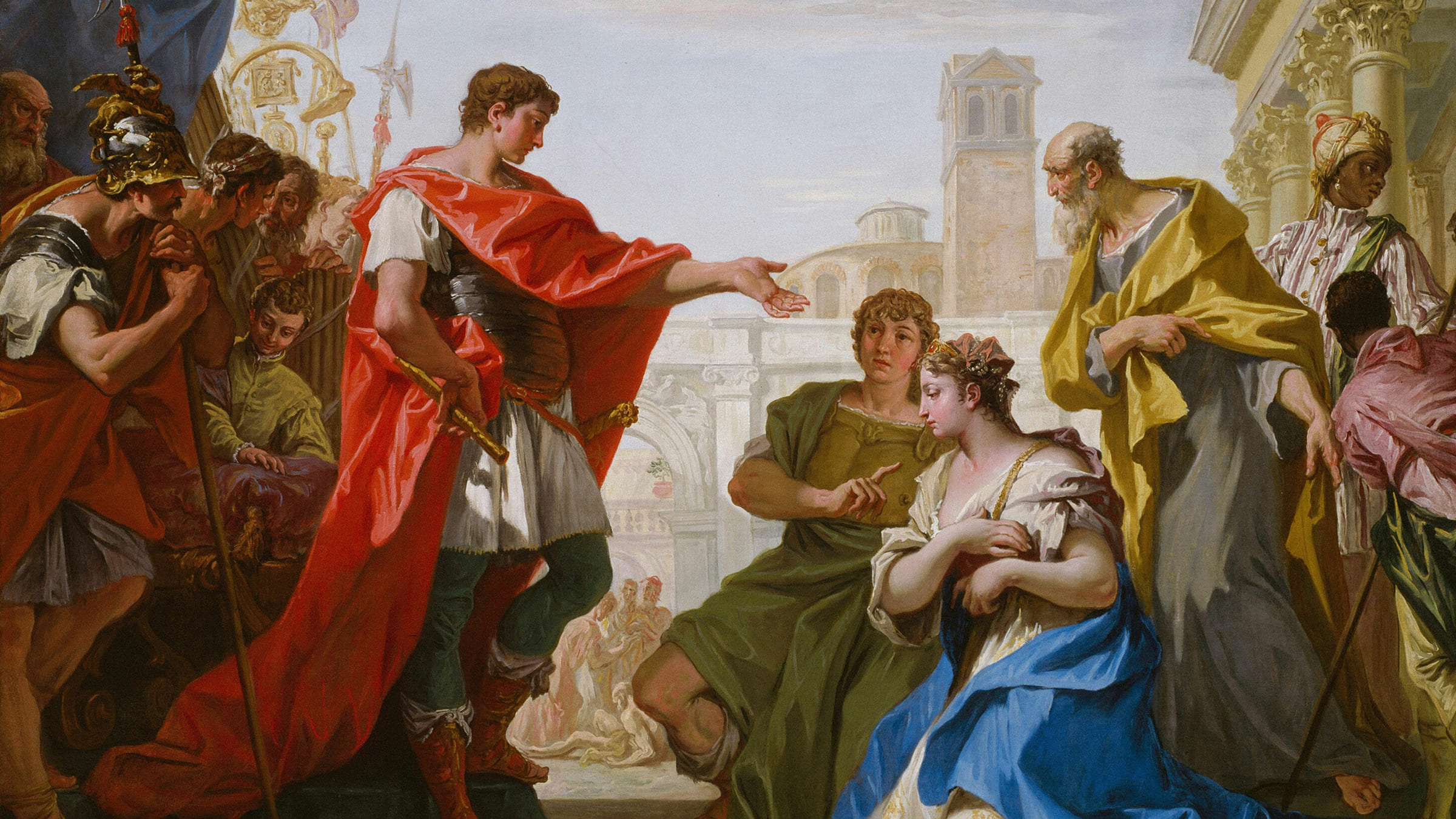
The Continence of Scipio

The Continence of Scipio

Artist: Nicolas Poussin Date: c. 1640 Medium: Oil on canvas Dimensions: 114.5 × 163.5 cm (45 × 64 3/8 in.) Period: Baroque, French Classical School

About This Painting

This painting shows a scene from Roman history: after conquering Carthaginian Spain, the general Scipio Africanus receives a young captive. Instead of claiming her as his right by war, he returns her to her betrothed prince and provides a dowry.

Nicolas Poussin painted this work in 1640. He spent most of his career in Rome, developing a style that combined classical composition with Baroque drama. The figures are arranged in a clear, balanced composition against classical architecture. The gestures and expressions convey the story's moral content.

Poussin uses classical architecture as a backdrop. The figures are carefully positioned to guide the viewer's eye through the narrative. The colors are rich, and the costumes show attention to historical detail. The composition emphasizes clarity and order rather than dramatic movement.

Baroque Context

Poussin represents the classical strand of Baroque art, emphasizing rational composition and clarity rather than the more dramatic style of Italian Baroque. His work shows how Baroque techniques could be adapted to express French classical values.

Like other Baroque artists, Poussin painted significant historical and moral moments. However, his approach differs from the dynamic style of Rubens or Caravaggio. Instead, he creates a balanced, ordered composition that allows viewers to understand the moral lesson clearly.

The subject celebrates virtue and self-control. Such works appealed to educated patrons who valued classical learning and moral instruction. The story of Scipio's continence was popular during this period as an example of leadership and virtue.

Historical Significance

This painting represents the height of French classical Baroque painting. Poussin spent most of his career in Rome, where he developed his distinctive style that would profoundly influence French academic painting for centuries. His work established principles of composition, clarity, and intellectual content that became fundamental to French art.

The painting exemplifies the Grand Manner—an approach to history painting that emphasized noble subjects, idealized figures, and moral content. This tradition, pioneered by Poussin, became the foundation of academic art theory and practice. The work demonstrates how ancient history could be made relevant to contemporary viewers through visual splendor combined with moral instruction.

Back to Gallery