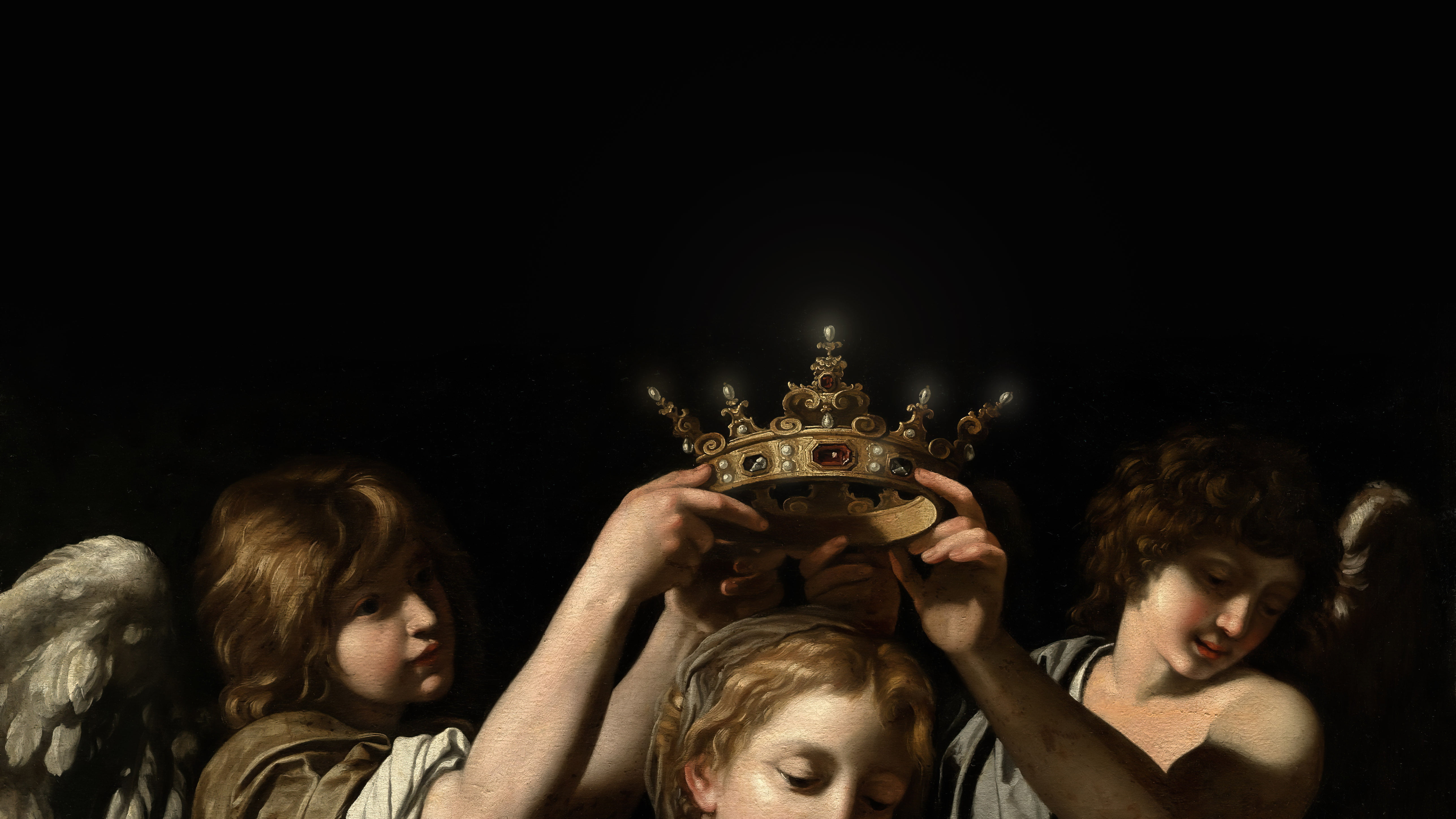
Coronation with Angels

Coronation with Angels

Artist: Bartolomeo Cavarozzi Date: c. 1615–1625 Medium: Oil on canvas Period: Baroque, Italian School

About This Painting

This striking Baroque composition depicts a divine or symbolic coronation: two angelic figures place an ornate golden crown upon the head of a third, against a deep black background. The crown itself seems to glow, its jewels and spires catching the light in a way that draws the eye to the sacred moment. The scene is rendered with strong chiaroscuro—the dramatic contrast between light and shadow typical of Baroque religious painting—giving the figures a sculptural, almost theatrical presence.

The leftmost figure, with a visible wing and soft, wavy hair, looks upward in profile as they help lower the crown. The central figure receives the crown with head slightly bowed, while the figure on the right gazes down with a contemplative expression. Their draped garments in muted gold, cream, and grey, along with the warm skin tones, stand out vividly against the darkness. Bartolomeo Cavarozzi creates an intimate yet majestic moment that balances reverence with emotional immediacy.

The painting exemplifies the Italian Baroque emphasis on divine glory and heavenly hierarchy. The radiant crown functions both as a literal object and as a symbol of spiritual elevation, while the angels' focused, tender gestures convey devotion and ceremony. Cavarozzi's handling of light—especially on the crown and the figures' faces and shoulders—shows the influence of Caravaggio's tenebrism while retaining a softer, more lyrical quality characteristic of his Roman circle.

Baroque Context

Bartolomeo Cavarozzi (c. 1587–1625) was an Italian Baroque painter active in Rome and later in Spain. He trained in Rome and was associated with the circle of Carlo Saraceni, through whom he absorbed Caravaggesque lighting and naturalism. His work often combined dramatic chiaroscuro with a refined, sometimes sweet treatment of religious and mythological subjects.

Coronation scenes—whether of the Virgin, saints, or allegorical figures—were popular in Counter-Reformation art, emphasizing the reward of the faithful and the glory of the Church. Cavarozzi's version focuses on the act of coronation itself, reducing the setting to darkness so that all attention falls on the figures and the luminous crown. This approach creates both intimacy and grandeur, aligning with the Baroque goal of moving the viewer through clarity and emotional impact.

The painting's strong light-and-shadow structure and the emphasis on a single, symbolic moment place it firmly within the Italian Baroque tradition. Cavarozzi's angels are rendered with a blend of naturalism and idealism that would have appealed to ecclesiastical and private patrons seeking dignified, emotionally engaging religious imagery.

Historical Significance

Cavarozzi worked during a period when Roman art was dominated by the legacy of Caravaggio and the emergence of the Bolognese and classical tendencies. His ability to fuse dramatic lighting with a gentler, more decorative sensibility made his work attractive to collectors and churches on both sides of the Alps. He spent time in Spain, where his style influenced local painters and helped transmit Italian Baroque ideas into Spanish collections.

This Coronation with Angels represents a type of devotional image that flourished in the early seventeenth century: focused, emotionally direct, and visually striking. The glowing crown and the reverent gestures of the angels would have served as a focus for meditation and devotion, while the technical skill and dramatic composition affirmed the continued vitality of religious painting in the Baroque age. The work remains a compelling example of how Italian Baroque painters could turn a single, symbolic moment into a powerful visual and spiritual experience.

Back to Gallery